
By then, the warning signs have usually been there for a while. A little extra bounce here, a clunk over a pothole there, and it all feels normal because it happened gradually.
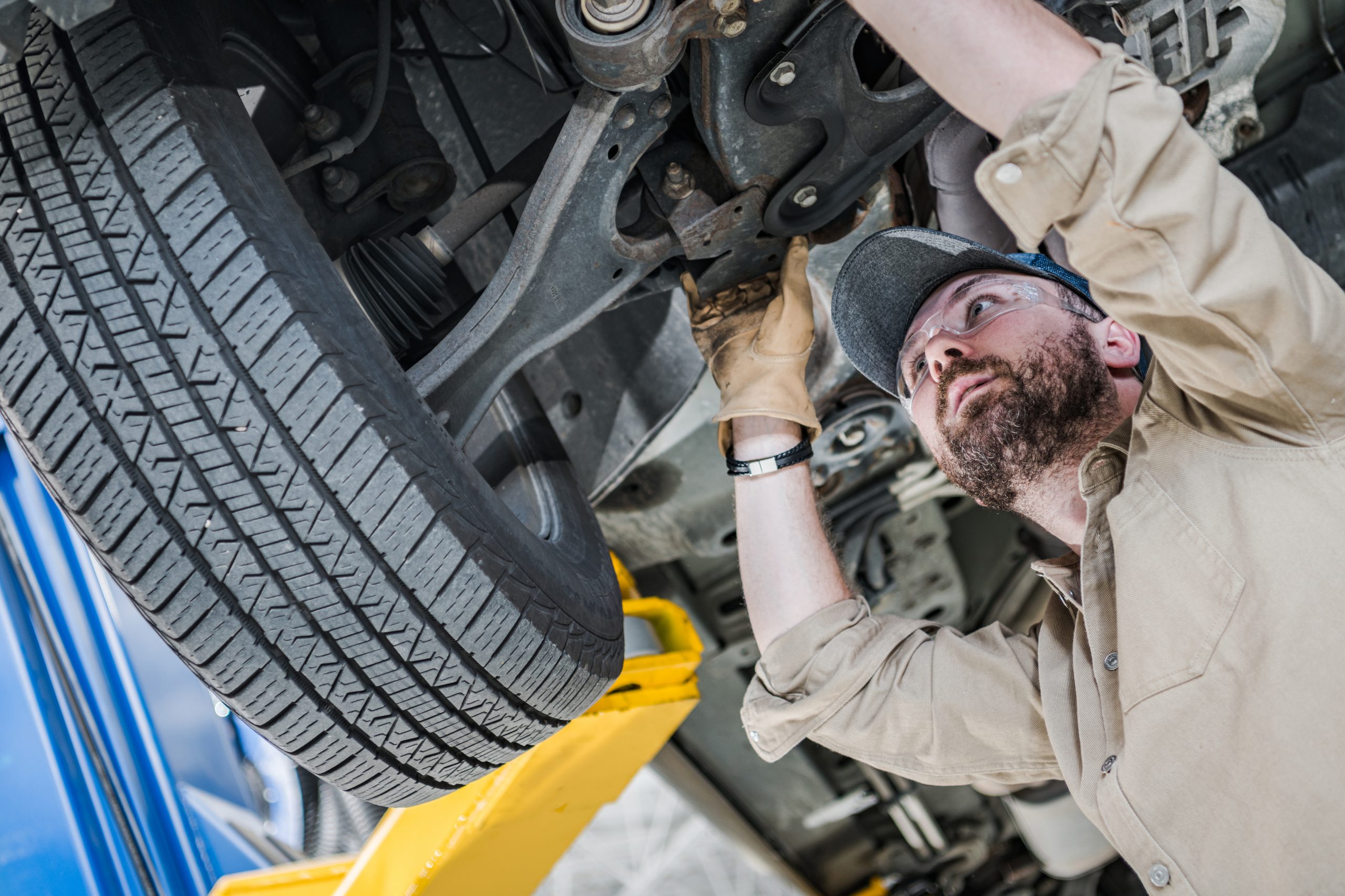
Your suspension system is what keeps the tires planted on the road and the car under control. It’s a network of connected parts: shocks and struts, coil springs, ball joints, control arms, tie rods, and bushings. When one of them wears out, you feel it in how the car rides, steers, and stops. Here are the five signs of bad suspension that Winchester drivers bring to us most often, what each one means, and how urgent it is.
1. The Ride Feels Rough or Bouncy
A car that bounces more than once after a bump has worn shocks or struts. Shocks and struts exist to absorb impacts and settle the car quickly. When they wear out, the springs keep oscillating and you feel every dip and seam in the road.
There’s a simple check you can do in your driveway. Press down hard on one corner of the car and let go. The car should rise and settle once. If it keeps bouncing two or three times, the shock or strut at that corner isn’t doing its job.
A rough ride is easy to get used to, and that’s the trap. Worn shocks and struts cost you more than comfort. When the tires skip and hop over bumps instead of gripping the road, your stopping distance increases and the car is harder to control right when it matters most, like a sudden stop or a swerve.
2. The Car Nose Dives, Rolls, or Squats
A car that leans hard during normal driving has suspension components that can’t control its weight anymore. Watch for three movements. The front end dives down when you brake. The body rolls to the side through corners. The rear end squats when you accelerate.
All three are the same problem showing up in different directions: worn shocks and struts letting the car’s weight shift too far, too fast. Nose diving is the one that matters most for safety. When the front end pitches forward under braking, weight leaves the rear tires and the car takes longer to stop. An emergency stop is the worst possible time to find that out.
If you feel yourself lurch forward during an ordinary stop at a light, it’s time for a suspension inspection.
3. Clunking or Knocking Over Bumps
A clunk, knock, or rattle when you hit a bump usually means a worn ball joint, control arm bushing, or sway bar link. These parts connect the suspension to the frame and let everything pivot as the wheels move. Each one has a joint or a rubber bushing that wears with age and miles. When the wear opens up play in the joint, the parts knock against each other over every imperfection in the road.
Noises are the sign drivers most often ignore, and the one we most wish they wouldn’t. A worn ball joint doesn’t heal. The play gets bigger, the clunk gets louder, and in the worst case a badly worn ball joint can separate, which can drop the wheel out of position while driving.
The good news: a clunk caught early is often a small repair. “We had a customer not long ago who’d been quoted a full strut replacement at another shop,” says Brad Hindman, owner and ASE Certified Master Technician at Mission Auto Repair. “The struts were fine. Two worn sway bar links were making all the noise. He paid for the links and drove home.”
4. The Car Drifts, Wanders, or Feels Loose
A car that won’t hold a straight line without constant small corrections often has worn steering and suspension parts, not just an alignment problem. Drifting and pulling can absolutely be an alignment issue, especially after a hard pothole hit or a curb strike. But when worn tie rods, ball joints, or control arm bushings put slack in the system, the steering develops the same wandering, disconnected feel, and an alignment won’t cure it because the parts move around on their own.
This is why we inspect the suspension before aligning a car that pulls. Aligning a vehicle with worn parts is like tuning a guitar with a loose tuning peg. It won’t hold. If the wheel feels vague on the highway, or the car needs constant shepherding to stay in its lane, have the components checked first. Alignment reaches further than most drivers realize, and we cover that side of the story in our guide to why wheel alignment affects more than tires.
5. Uneven Tire Wear or a Car That Sits Low on One Corner
Uneven tire wear and a car that sits lower on one corner are both physical evidence of suspension problems. Two things to check. First, look at the tread. With healthy suspension and regular rotations, all four tires wear evenly across the full tread face. Cupped, scalloped, or patchy wear means the tire is bouncing and scrubbing instead of rolling flat, which points back at worn shocks, struts, or related components.
Second, look at how the car sits on level ground. If one corner sags lower than the others, a coil spring has likely weakened or broken on that corner. A sagging corner changes how the car handles and loads the parts around it, so it deserves prompt attention.
Both checks take under a minute and cost nothing. They’re the closest thing your suspension has to a warning light.
Is It Safe to Keep Driving on Bad Suspension?
For a while, usually. Indefinitely, no. Suspension problems are progressive. Worn parts load up the parts around them, so a cheap repair ignored becomes an expensive one later. And the safety cost shows up before the breakdown does: longer stopping distances, poorer grip in rain and snow, and less control in emergency maneuvers.
Treat loud clunks, a separating or vague steering feel, and a visibly sagging corner as urgent. Treat a gradually rougher ride as a reason to book an inspection soon, before winter roads raise the stakes.
A proper steering and suspension inspection checks the whole system, not just the part making noise. That matters because suspension symptoms overlap. Finding the actual worn part first means you only pay to fix what’s broken. Kelley Blue Book’s guide to suspension warning signs makes the same point: the symptoms are easy to spot, but pinpointing the cause takes a proper inspection.
Frequently Asked Questions
What are the most common signs of bad suspension?
The five most common signs are a rough or bouncy ride, nose diving when braking, clunking noises over bumps, a drifting or loose steering feel, and uneven tire wear or a car that sits low on one corner. Any one of them is reason for an inspection.
How long do shocks and struts last?
Most shocks and struts last somewhere between 50,000 and 100,000 miles, but road conditions and driving style move that number a lot. Frequent gravel roads, potholes, and heavy loads all shorten the lifespan. The bounce test and a periodic inspection are more reliable than the odometer.
Can I drive with a clunking noise in my suspension?
You can, but you shouldn’t for long. Clunking usually means a worn ball joint, bushing, or sway bar link, and the wear only grows. A badly worn ball joint can fail completely while driving. Get the noise diagnosed promptly. It’s often a smaller repair than it sounds.
Is it my suspension or my alignment?
They overlap, which is why this confuses people. Pulling to one side with even steering feel is usually alignment. Wandering, vagueness, or clunks point to worn suspension parts. Worn parts also throw off alignment, so a proper inspection checks the components before any alignment is done.
Why does my car bounce so much over bumps?
Extra bouncing means the shocks or struts can’t dampen the springs anymore. The spring keeps oscillating after the bump instead of settling. Try the bounce test: push down on a corner and release. More than one rebound means that corner needs attention.
What happens if I ignore suspension problems?
The wear spreads. Worn shocks accelerate tire wear, worn ball joints stress control arms, and small repairs grow into big ones. Braking distance and handling also degrade the whole time, which is a safety cost you pay on every drive, not just when something finally breaks.
If your car is showing any of these five signs, call Mission Auto Repair in Winchester, VA and describe what you’re feeling and when it happens. Suspension repairs here are backed by our 2-Year/24,000-Mile Warranty, so the fix is done once and done right.