

Why Is My Car AC Blowing Hot Air?
The most common causes are a refrigerant leak, a failing compressor, a blocked condenser, an electrical fault, a stuck blend door, or a broken cooling fan. Some are simple repairs. Others need professional diagnostics. The right answer depends on what’s actually wrong with your system.
1. Refrigerant Leak
Refrigerant is the fluid that makes cooling possible. It circulates through the AC system, absorbing heat from your cabin and releasing it outside the vehicle. When the level drops too low, the system can’t cool, no matter how well everything else is working.
Refrigerant leaks are rarely obvious. Unlike oil or coolant, refrigerant evaporates when it escapes. You won’t find a puddle under your car. Sometimes a slow leak leaves a faint oily residue near the source, but it’s not always visible without knowing where to look.
Leaks develop in a few common places. Old or cracked hoses are a frequent source. A rusted evaporator core is another. Degraded O-rings and fittings can also allow refrigerant to escape slowly with no obvious signs.
Finding the exact location takes professional equipment. Our technicians inject fluorescent dye into the system and use a UV light to trace where it’s escaped. We also use an electronic refrigerant detector to catch leaks too small to produce visible dye traces. Once we confirm the source, we repair the leak and recharge the system to factory specification.
2. Worn Out or Broken Compressor
The compressor drives the entire AC system. It pressurizes the refrigerant and pushes it through the cooling cycle. When the compressor fails, refrigerant stops moving properly and cooling performance drops. In some cases, the added strain on the engine can contribute to overheating.
Compressor problems are especially common after a long Virginia winter. When the air conditioning sits unused for months, the lubricating oil inside the compressor settles. Starting it back up after that extended rest can expose wear that wasn’t noticeable before. Many newer vehicles address this by running the compressor briefly under the defrost setting throughout the year, which keeps it lubricated.
One habit that extends compressor life: run the AC on its highest setting for a few minutes once a month, even in winter. It keeps the system lubricated and helps you catch developing problems before the first hot day of spring.
If the compressor has already failed, running the system further can cause more damage. Our team checks the compressor in every AC diagnostic and tells you whether it can be serviced or needs to be replaced.
3. Electrical System Fault
The AC system doesn’t run on mechanical parts alone. A network of fuses, relays, switches, and control modules governs when and how each component operates. If any one of those elements fails, it can shut down part or all of the AC, even when the mechanical components are fine.
Electrical faults are harder to diagnose without the right equipment. Warm air from the vents looks the same whether the compressor clutch relay has failed or the compressor itself is the problem. That distinction matters a lot for the cost and complexity of the repair.
Our diagnostic process tests the compressor clutch, associated relays, control signals, and relevant fuses. We find exactly where in the electrical chain the fault is before any parts are ordered.
4. Blocked or Damaged Condenser
After refrigerant absorbs heat from your cabin, it needs to release that heat before cycling back through the system. That’s the condenser’s job. It sits at the front of the vehicle between the radiator and the grille, using airflow to cool the refrigerant back down. When the condenser can’t do that job, the refrigerant stays warm and hot air reaches your vents.
Condenser problems come in two forms. The first is a physical blockage. Leaves, bugs, small rocks, and dirt can build up in the grille and restrict airflow. It’s worth checking yourself before assuming a more serious issue. Clearing debris occasionally resolves the problem without a shop visit.
The second is physical damage. The condenser sits right at the front of the vehicle, which makes it vulnerable to road debris and minor collisions. If your AC problems started after a fender bender or driving through debris, the condenser may have been punctured or bent.
If clearing the grille doesn’t restore cooling, bring the vehicle in. We inspect the condenser for blockage, damage, and refrigerant flow restriction.
5. Stuck Blend Door
When you start your engine, warm air from the engine bay flows through the ventilation system toward the cabin. The blend door (sometimes called the air mix door) controls how much warm air enters versus how much cooled air from the AC comes through. Set the temperature to cold, and the blend door positions itself to block warm air and let cool air in.
When the blend door sticks, or the actuator motor that moves it fails, that balance breaks down. The door can stay in a position that allows warm air in regardless of your temperature setting. It feels like the AC isn’t working at all, even when the rest of the system is fine.
Blend door issues are often misdiagnosed as compressor or refrigerant problems because the symptoms look the same from the driver’s seat. Identifying the blend door as the source avoids unnecessary and expensive compressor or refrigerant work.
6. Broken Cooling Fans
Two cooling fans help the condenser release heat from the refrigerant. They matter most when the vehicle is stationary or moving slowly, when there isn’t enough natural airflow through the grille to cool the condenser on its own. When one or both fans are damaged or running at the wrong speed, the refrigerant doesn’t shed heat and warm air reaches the cabin.
Fan damage usually comes from road debris striking the blades. Cracks or chips reduce efficiency significantly. In some cases, debris lodges between the blades and slows or stops them without causing visible external damage.
Before assuming the fans need replacing, check that nothing is caught between the blades. If the fans look clear but the AC is still underperforming, bring it in. A damaged fan needs to be replaced by a qualified shop.
Our AC Diagnostic Process
We don’t recommend repairs based on guesswork. Every AC diagnosis at Mission Auto Repair follows a structured process to find the actual cause before any parts are ordered.
Step 1 – System Performance Check: We record temperatures at the vents and compare them against the expected output for your vehicle. This tells us immediately how far the system is from operating correctly.
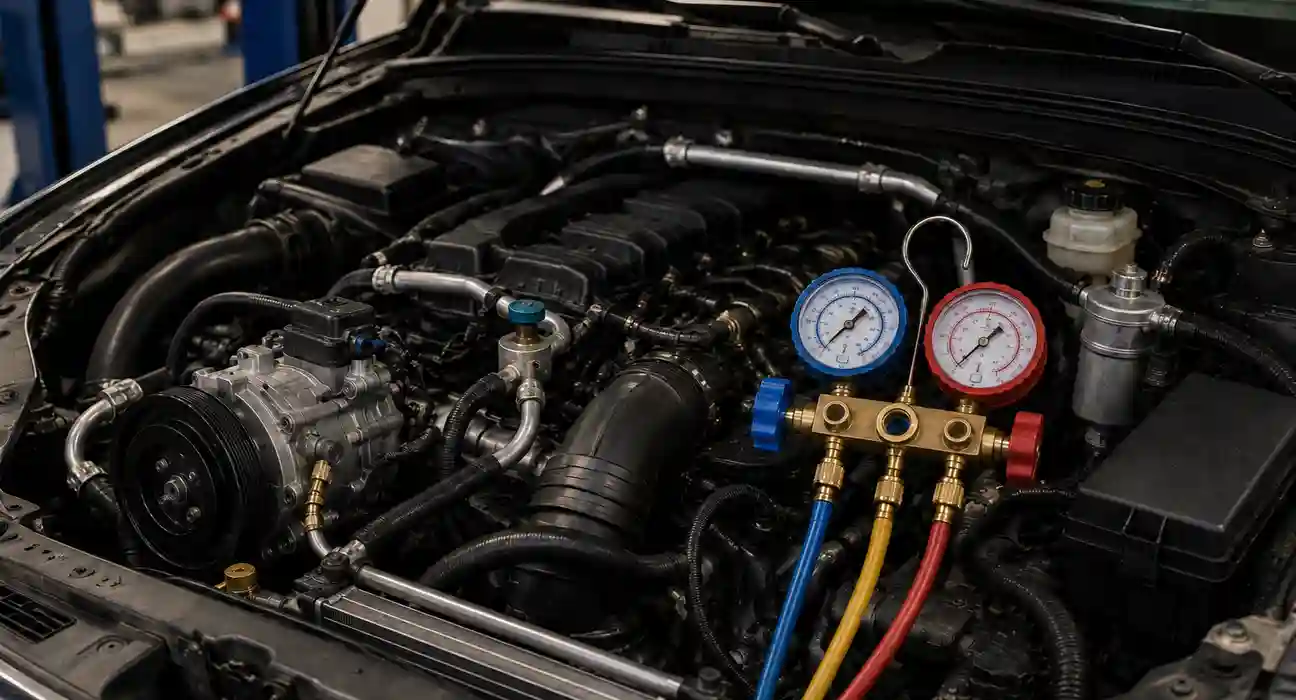
Step 2 – Refrigerant Pressure Testing: We connect gauges to both the high and low sides of the system and record live pressure readings. Abnormal readings point us toward specific components and confirm or rule out a refrigerant charge issue.
Step 3 – Leak Detection: We use fluorescent dye injection with UV light inspection and an electronic refrigerant detector together. Using both methods ensures we catch leaks regardless of size or location.
Step 4 – Electrical and Component Testing: We test the compressor clutch, relays, cooling fans, and blend door actuator to confirm every electrical component is working. This step is critical for distinguishing electrical faults from mechanical ones.
Step 5 – Visual Inspection: We inspect the condenser, hoses, fittings, and all accessible components for physical damage, blockage, corrosion, or wear that may not show up in pressure or electrical testing.
Step 6 – Repair and Recharge: Once we confirm the cause, we carry out the repair and recharge the system to factory specification. A final performance check confirms the system is cooling correctly before your vehicle leaves our shop.
AC Repair in Winchester, VA | Why Choose Mission Auto Repair
Mission Auto Repair is a family-owned shop in Winchester staffed by ASE-certified technicians. Here’s what you get when you bring your vehicle to us:
- ASE Certified Master Technicians: Brad Hindman leads our shop with ASE Master Technician certification. That reflects the highest standard of competency in the industry.
- 25+ years of experience: We’ve been diagnosing and repairing AC systems in Winchester’s heat for over two decades.
- 2-Year/24,000-Mile Warranty: Every repair we do is backed by our industry-leading warranty. Most shops don’t come close to this coverage.
- Upfront, transparent pricing: You get a clear, itemized quote before any work begins. No surprises. No upsells.
- Fast turnaround: Most AC repairs are completed same day. We know going without a working vehicle in Virginia summer heat isn’t a small inconvenience.
- Multi-method leak detection: We use fluorescent dye, UV inspection, and electronic detection together. A single-method approach misses leaks ours finds.
We also donate a portion of proceeds from every service to the Winchester Rescue Mission, funding meals and overnight stays for neighbors in need. Every repair we do here does two jobs.
For more on our full repair capabilities, see our AC repair service page.
Frequently Asked Questions
Why is my car AC blowing hot air all of a sudden?
Sudden hot air most often points to a refrigerant leak that’s dropped the charge below the level needed for cooling, a compressor that’s stopped engaging, or an electrical fault that’s interrupted the system. A diagnostic visit finds the exact cause quickly.
Can I recharge the A/C myself and fix the problem?
A DIY recharge can temporarily restore cooling if low refrigerant is the only issue. But it doesn’t fix the underlying leak that caused the refrigerant level to drop. The charge will drop again. In the meantime, moisture and air that entered through the leak can corrode internal components. There’s also a legal dimension: the EPA regulates how refrigerants can be handled and who can purchase them. A proper repair seals the leak before recharging, and puts the work in certified hands.
How do I know if my AC compressor has failed?
Common signs include warm air from the vents, a noise when the AC engages, the AC clutch not engaging when you turn the system on, or the engine running hotter than usual. A pressure test and clutch inspection confirms whether the compressor is the source.
Why does my AC blow cold for a while and then turn warm?
Intermittent cooling that starts cold and gradually warms up is often caused by a slow refrigerant leak, a freezing evaporator due to moisture in the system, or a compressor clutch that engages inconsistently. Each requires a different repair, which is why accurate diagnosis matters.
Do you work on trucks and SUVs?
Yes. We diagnose and repair AC systems on cars, trucks, SUVs, and vans, domestic and foreign, including hybrid vehicles. If it drives in Winchester, we work on it.
How long does an AC repair take?
It depends on what’s wrong. Correcting a refrigerant charge issue can be done in a single visit. A compressor or condenser replacement takes longer. We give you a realistic time estimate after the diagnostic is complete.
Can a broken AC cause other problems with my car?
Yes. A failing compressor puts extra load on the engine and can contribute to overheating. A refrigerant leak that goes unaddressed allows moisture into the system, which speeds up corrosion of internal components. Fixing AC problems promptly protects the rest of the system.
Get Your Air Conditioning Diagnosed in Winchester Today
Don’t spend another summer drive sitting in warm, stale air. If your AC is blowing hot air and you’re looking for AC repair near me in Winchester, call Mission Auto Repair or book your appointment online. We’ll find out exactly what’s wrong, give you a clear price to fix it, and get you back on the road cool and comfortable.
Serving Winchester, Frederick County, Stephens City, Middletown, Berryville, and surrounding communities.
Ready to book? Call us or visit our AC repair page to learn more.