

What Your Car’s AC Actually Does
Your AC does two things at once: it cools the cabin and pulls humidity out of the air. That’s what makes summer driving in Virginia’s climate genuinely comfortable rather than just slightly less miserable.
Most drivers know the AC keeps things cool, but the dehumidifying part often gets overlooked. As warm cabin air passes across the evaporator core, both heat and moisture get pulled out before the air comes back through your vents.
When a component in that system starts to wear or fail, the stress it creates often shows up as sound before any other symptom. What you hear, and when you hear it, gives your technician valuable information before the diagnosis even starts.
How to Tell If the Noise Is Coming From Your AC
Turn the AC on and off while the engine is running and listen for whether the noise follows. If it appears when the AC engages and disappears when you switch it off, the source is in the AC system. If the noise is there regardless, the issue is probably elsewhere in the engine.
Once you’ve confirmed the AC is involved, the type of noise narrows things down considerably.
Common Car AC Noises and What They Mean
Knocking or Clicking When the AC Runs
Clicking or knocking that starts when the AC turns on usually means something is loose. Bolts and brackets that secure A/C components can work themselves loose over time from constant vibration and temperature swings.
If you’re comfortable doing so, open the hood and observe from a safe distance with the engine running. Any component that appears to be vibrating more than its surroundings is worth noting. A technician can identify and tighten the source quickly.
In our experience, the most common culprit is loose compressor mounting bolts. The compressor cycles on and off constantly and takes more vibration stress than almost anything else under the hood, so those bolts work themselves loose over time.
Buzzing From the Engine Bay
A buzzing noise during A/C operation frequently signals the compressor is under stress. The most common cause is an overcharged system. That means too much refrigerant has been put in at some point.
When there’s too much refrigerant, liquid can enter the compressor’s intake and cause it to vibrate under the load. That accelerates wear. Left uncorrected, it can lead to full compressor failure.
The most common cause we see is a DIY recharge kit. They make it easy to add refrigerant but give you no way to check whether the system actually needed it.
Hissing From the AC
A brief hiss right after turning the AC off is normal. When the compressor stops, pressure between the high and low sides of the system equalizes. The sound you hear is refrigerant moving between those two sides. It isn’t a cause for concern on its own.
If the hissing is constant while the system is running, or if you notice reduced cooling or warm air from the vents alongside it, that’s a different story. Those signs together point toward a refrigerant leak and warrant a proper inspection.
Rattling When the AC Is On
Rattling while the AC is engaged is one of the harder noises to diagnose. Several different things can cause it. A worn serpentine belt, a failing compressor pulley bearing, or a deteriorating compressor can all produce a rattling sound. So can a faulty compressor clutch, though that’s less common.
Because the source isn’t always visible, this is one noise we strongly recommend having a technician investigate rather than trying to troubleshoot on your own.
Squealing When the AC Turns On
A high-pitched squeal at the moment the AC engages usually points to a belt under stress. The compressor adds load to the serpentine belt when it kicks in. A belt that’s worn, glazed, or slightly loose will squeal under that extra tension.
A belt showing that symptom is close to the end of its service life. It should be replaced before it fails and takes other engine accessories down with it.
Banging From the Compressor Area
A louder banging or clunking near the compressor is one of the more serious sounds on this list. It can mean internal components inside the compressor have failed, or that the clutch is making contact in a way it shouldn’t be.
If you hear this, don’t keep running the system. Have the vehicle inspected promptly.
Our AC Noise Diagnostic Process
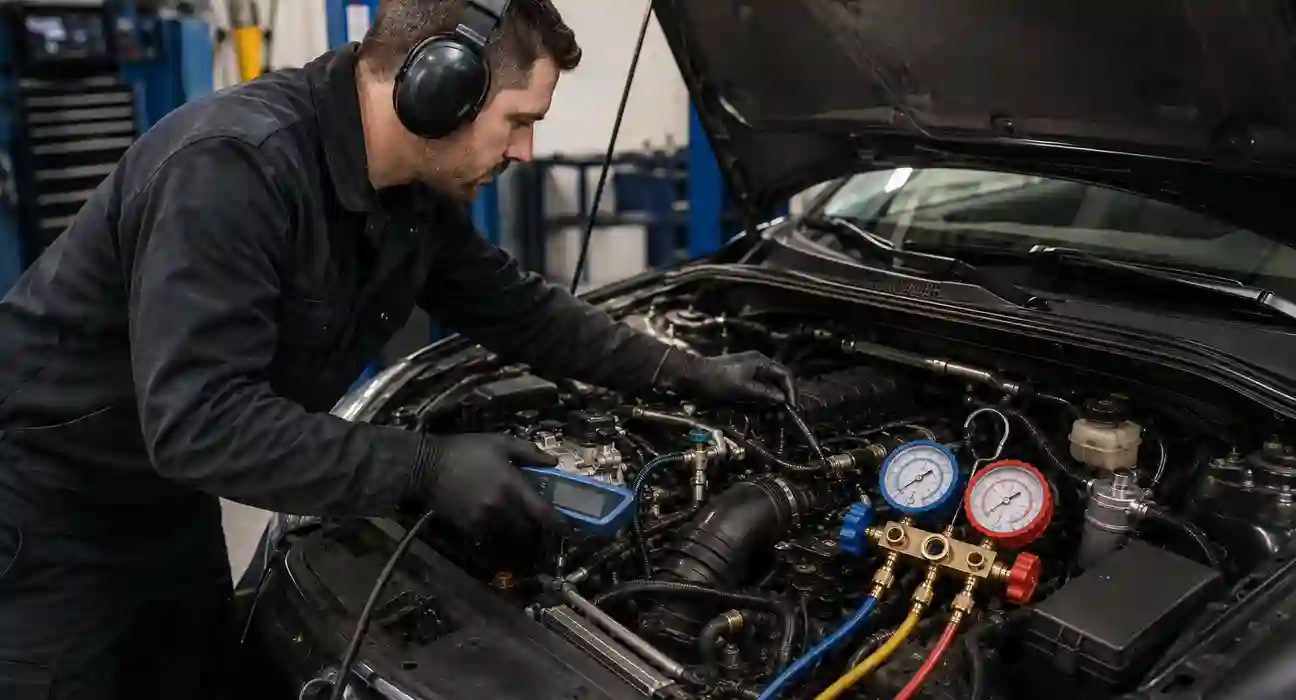
We follow a structured diagnostic process to locate the source accurately before recommending any repair. Here’s how it works.
Step 1 – System Engagement Test: We cycle the A/C on and off under different conditions: varying RPM, fan speed, and temperature. That tells us exactly when the noise occurs and what changes it. This narrows down which component is involved before we look more closely.
Step 2 – Belt and Pulley Inspection: We inspect the serpentine belt, compressor pulley, tensioner, and idler pulleys for wear, cracking, and misalignment. Belt and pulley issues are among the most common sources of AC noise. They’re also among the more straightforward repairs when caught early.
Step 3 – Compressor Assessment: We check the compressor for signs of overcharge, internal stress, and clutch wear. We record refrigerant pressure on both the high and low sides. That confirms the system is running within the correct range for your vehicle.
Step 4 – Mount and Hardware Inspection: We check all mounting brackets, bolts, and fasteners throughout the A/C system for looseness or deterioration. A single loose component can amplify vibration and produce noise that sounds far more serious than it is.
Step 5 – Compressor Clutch and Electrical Testing: We test the compressor clutch, relays, and control signals to confirm the clutch is engaging and disengaging cleanly. A clutch that slips or engages roughly is a common noise source. It often gets mistaken for a more expensive problem.
Step 6 – Full System Performance Verification: Once the repair is complete, we run a full performance check to confirm the system is running quietly and correctly before your vehicle leaves the shop.
Repairs We Perform
Belt and Pulley Replacement
We replace worn serpentine belts, tensioners, and pulleys with quality components sized correctly for your vehicle. This is one of the more common and cost-effective fixes for AC squealing and rattling.
Compressor Repair and Replacement
When the compressor is confirmed as the source, we assess whether a refrigerant correction will resolve it or whether the unit needs replacing. We install OEM-grade compressors and handle both R-134a and R-1234yf refrigerant systems.
Compressor Clutch Service
In many cases, a worn clutch can be replaced on its own without replacing the entire compressor. That reduces both parts and labor costs. We evaluate each situation individually and recommend the most cost-effective approach.
Refrigerant Correction
If an overcharged system is causing buzzing or stressing the compressor, we evacuate the excess and recharge to the exact factory specification for your vehicle.
Mount and Hardware Service
Loose or corroded mounting hardware is a quick fix when caught early. We tighten or replace fasteners and brackets throughout the system to eliminate vibration noise at the source.

Why Ignoring AC Noise Costs More Over Time
Every noise your AC makes is a sign that mechanical energy is going somewhere it shouldn’t. None of these situations fix themselves. Most get worse with each drive until something fails outright.
A loose mount lets surrounding components vibrate against each other and wear faster than they should. A compressor running on an overcharged system deteriorates ahead of schedule. A slipping belt puts strain on every accessory it drives.
Catching the issue at the noise stage almost always means a simpler repair and a lower bill than addressing the same problem after a component has failed completely.
Why Winchester Drivers Choose Mission Auto Repair
- ASE-Certified Master Technician with 25+ Years of Experience – Brad Hindman holds the highest certification in the industry and has been diagnosing and repairing vehicles for over 25 years. You get expert work, not guesswork.
- Structured Diagnostic Process – We don’t guess at the source of a noise. Every diagnosis follows a methodical process so the repair we recommend is the correct one.
- 2-Year/24,000 Mile Warranty – Every repair we perform is backed by one of the strongest warranties in the area. If something isn’t right, we make it right.
- Upfront, Transparent Pricing – You get a clear, itemized quote before any work starts. No surprises at pickup.
- Same-Day Turnaround – Most A/C noise diagnostics and straightforward repairs are completed the same day.
- Family-Owned and Community-Rooted – We’re part of Winchester. We treat every vehicle the way we’d want our own treated, and we stand behind every repair we perform.
Frequently Asked Questions
Is it safe to keep driving with a noisy AC?
It depends on the noise. A brief hiss after the system shuts off is normal. A rattling, banging, or persistent buzzing while the system runs means something is under stress or failing. Continuing to run the AC in that condition can accelerate compressor damage. Have it checked sooner rather than later.
How do I know the noise is coming from the AC?
Turn the AC on and off while the engine is idling and listen for whether the noise follows the system. If it appears and disappears with the AC, the source is almost certainly in the A/C system. If the noise is there regardless, the issue is likely unrelated.
What is the most common cause of AC noise?
In our experience, roughly half the noisy AC jobs we see come down to belt or pulley wear, followed by refrigerant charge issues affecting the compressor. Both are straightforward to address when caught early.
Do you work on trucks and SUVs?
Yes. We service cars, trucks, SUVs, and vans, domestic and foreign, including hybrid vehicles. If it’s got an AC system, we can diagnose and repair it.
How much does it cost to fix a noisy AC?
The cost depends on what’s causing the noise. A loose bracket is a minimal repair. A failing compressor involves more parts and labor. We give you a full diagnosis and a clear price before any work begins, so you know exactly what you’re looking at before we start.
My AC is noisy but still blowing cold. Should I still bring it in?
Yes. A system that’s still cooling but making unusual noise is in the early stages of a developing problem. Addressing it now, while it’s functional, is almost always less expensive than waiting until the noise leads to a complete failure.
Schedule Your AC Noise Diagnosis in Winchester, VA
Don’t let a noise that starts small turn into a repair that didn’t have to happen. Call Mission Auto Repair or visit our AC repair page to book your appointment. Our ASE-certified team will find the source, explain the fix, and get your air conditioning running quietly again.
Serving Winchester, Frederick County, Stephens City, Middletown, Berryville, and surrounding communities.