

Most drivers think wheel alignment is just a tire problem. They notice uneven tire wear or a pull to one side. But bad alignment affects much more than your tires. It puts stress on suspension parts. It hurts your gas mileage. It makes your car take longer to stop. On newer cars, it can also throw off the safety sensors that protect you. These sensors are part of Advanced Driver Assistance Systems, or ADAS for short.
The real cost of ignoring alignment isn’t just buying new tires too soon. Hidden damage builds up in parts you can’t see. On cars with ADAS, your safety features may stop working the way they should. This guide explains what alignment is. It covers the warning signs to watch for. It shows how bad alignment affects your whole car. And it explains why the right tools matter when you need service.
What Wheel Alignment Affects Beyond Your Tires
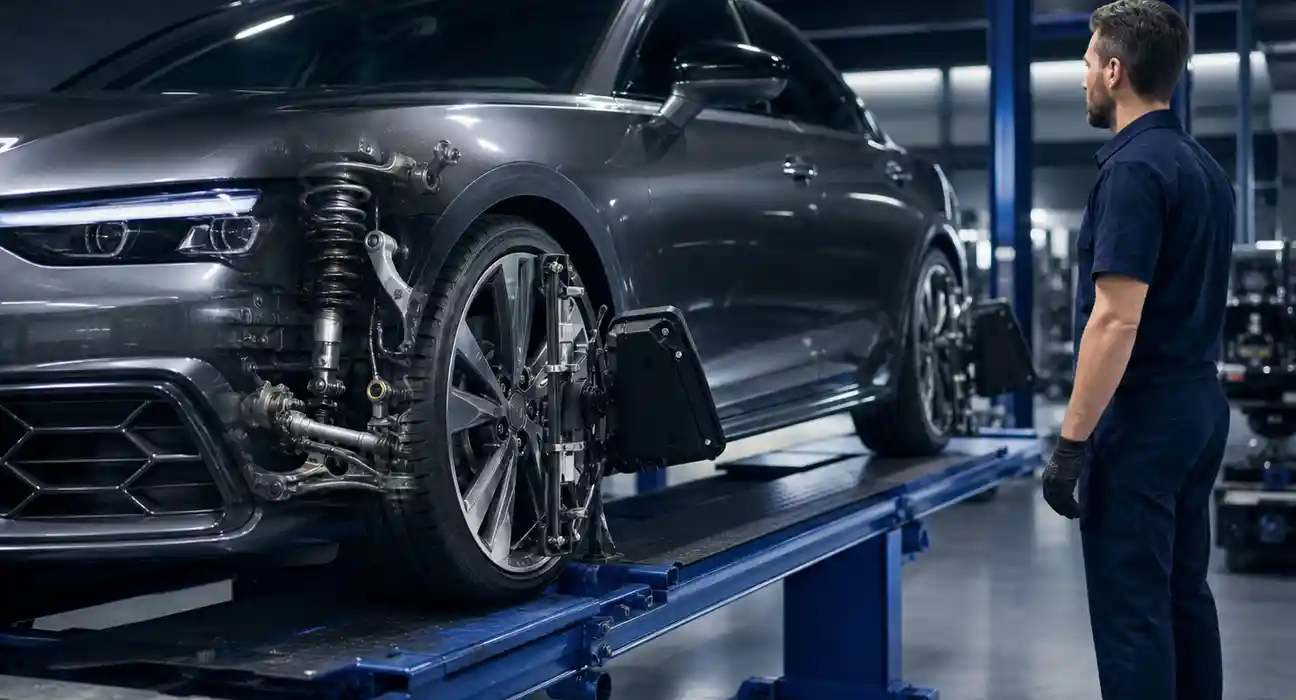
Wheel alignment is the adjustment of your car’s suspension. The suspension is the system that connects your wheels to the car’s frame. When alignment is off, your tires hit the road at the wrong angles. This sets off a chain reaction through your whole car.
Misaligned wheels cause pulling and drifting. This makes the car harder to control, especially in turns. The wrong angles also create more rolling resistance. Your engine has to burn more fuel just to keep up speed. Your suspension and steering parts take stress they weren’t built for. This wears out parts like ball joints and shocks too soon. On newer cars, the change in wheel angles can also shift your car’s thrust line. The thrust line is the path your car actually travels. ADAS sensors point along this line. When it shifts, the sensors point in the wrong place. We’ll explain that more below.
Wheel alignment adjusts three specific angles. Each one changes how your tires meet the road. Knowing these basics helps explain why bad alignment causes so many problems.
Camber
Camber is how your tire tilts in or out when you look at it from the front of your car.
- Positive camber: The top of the tire leans out, away from the car.
- Negative camber: The top of the tire leans in, toward the car.
When camber is off, one side of your tire carries more weight than the other. Over time, that side of the tread wears down much faster than the center. This can cut your tire life in half.
Caster
Caster is the angle of your steering when you look at it from the side of the car. Picture a line running through your steering parts. Caster shows whether that line tilts forward or back.
This angle controls how your steering wheel comes back to center after a turn. Good caster keeps your car steady at highway speeds. It also helps the wheel straighten on its own. When caster is off, your car can feel loose or wobbly. You’ll need to make small steering corrections just to stay in your lane.
Toe
Toe is whether your tires point in or out when you look at them from above. It’s like looking down at your own feet.
- Toe-in: The fronts of the tires angle toward each other.
- Toe-out: The fronts of the tires angle away from each other.
Toe problems are the most common cause of fast tire wear. Even a small toe issue causes your tires to scrub against the road instead of rolling cleanly. Just 1/8 inch off can equal 28 feet of sideways scrubbing for every mile you drive. That’s a lot of extra wear, every single trip.
 How Misalignment Causes Uneven Tire Wear
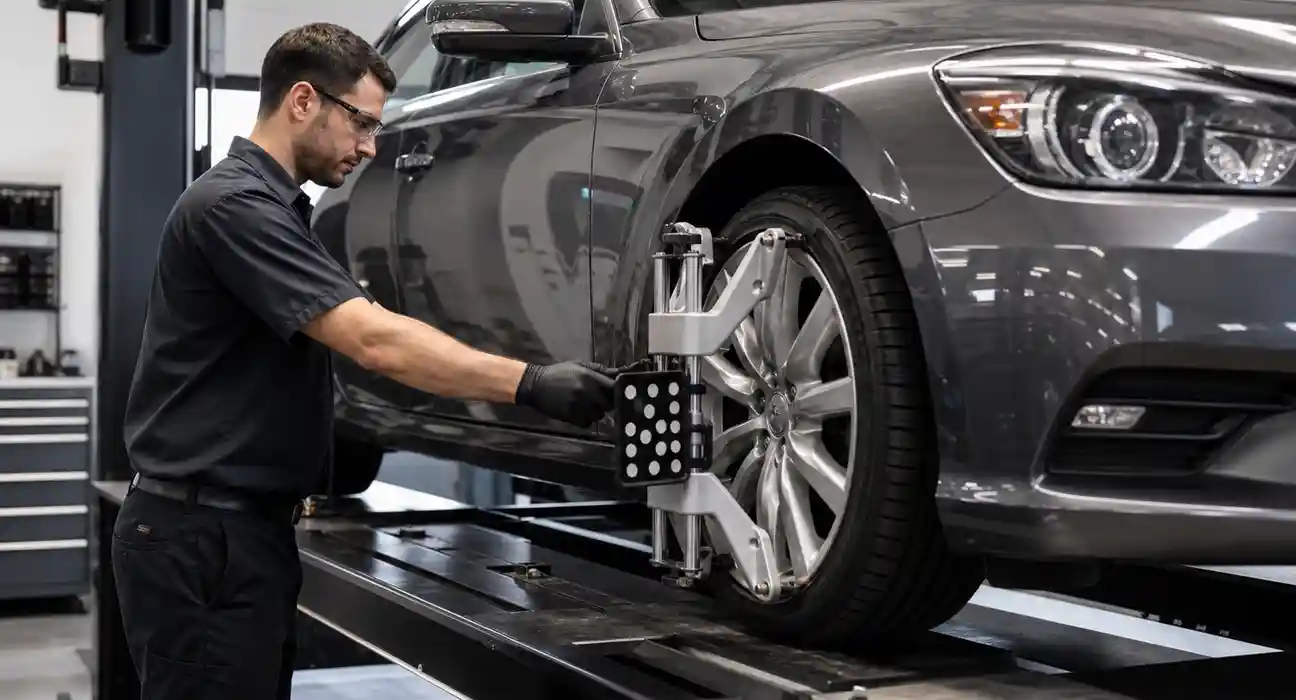
Misalignment causes uneven tire wear in a simple way. Your tires drag at small angles instead of rolling straight. This grinds away rubber in patterns you can spot.
When your wheels are aligned right, your tires roll straight. Wear spreads evenly across the whole tread. Bad alignment changes that completely. Instead of rolling, your tires drag at small angles, grinding away rubber in predictable patterns.
These wear patterns can show you exactly what’s wrong. Spotting them early can save you from buying new tires too soon.
Inner and Outer Edge Wear
This pattern usually means camber problems. One side of the tread will wear down much faster than the rest. It could be the inner edge closer to the car or the outer edge.
What to Look For: Run your hand across the tread from side to side. If one edge feels lower or smoother than the other, camber is likely the cause. If you don’t fix it, this wear pattern can cut your tire life in half.
Feathering and Cupping Patterns
Feathering creates a unique texture. The tread feels smooth on one side and sharp on the other, like saw teeth. Cupping creates wavy dips that go around the tire.
Feathering usually means toe alignment problems. Cupping often points to worn suspension parts plus misalignment. The bouncing plus the wrong angles create those dips in the tread.
One-Sided Tread Loss
Sometimes only one tire shows heavy wear while the others look fine. This means the alignment is off on that one wheel. It often happens after hitting a pothole or curb on one side of the car.
Red Flag: If you keep replacing tires on one side, or one tire always wears out first, get an alignment check. If you don’t fix the alignment problem, you’ll keep buying new tires that wear out too fast.
What Wheel Alignment Affects Beyond Your Tires
Wheel alignment affects much more than tires. It also impacts your suspension parts, fuel economy, braking distance, ride comfort, and ADAS safety systems on modern cars.
Tires are just the first thing to fail from bad alignment. The real damage often hides in parts under your car. On modern cars, it can also harm safety systems most drivers don’t link to alignment at all. A simple alignment service can prevent much bigger repair bills and safety problems later.
Suspension and Steering Parts
Bad alignment forces your suspension and steering parts to work under constant stress. These parts are made to absorb bumps and give you smooth handling. Instead, they fight against the wrong angles with every mile you drive.
Parts at risk include:
- Ball joints: Connect your control arms to the steering parts.
- Tie rod ends: Connect your steering to the wheels.
- Control arm bushings: Cushion the joints between control arms and the frame.
- Wheel bearings: Let your wheels spin smoothly.
Pro Tip: When you replace any suspension or steering part, get the alignment checked right away. This protects your investment. New parts on a misaligned car can wear out fast, sometimes in just a few thousand miles.
Fuel Economy and Engine Strain
Misaligned wheels create rolling resistance. This means your tires fight against the way the car is moving. Your engine has to burn more fuel just to keep the same speed. Studies from major tire makers show that bad alignment can hurt your fuel economy by up to 10%. Over a year of driving, that adds up to real money at the pump.
Meanwhile, your drivetrain parts work harder than they should. This wears them out faster.
Braking Distance and Vehicle Safety
When your wheels point in different directions, your car may pull to one side when you brake. This pulling makes you take longer to stop. It also gives you less control in emergencies.
Red Flag: If your car pulls hard to one side when you brake, alignment problems may be hurting your safety. Get this checked right away, especially if it happens during hard braking.
Ride Comfort and Driver Fatigue
Making constant small steering corrections wears you out on long drives. You might not notice the extra work at first. But your hands and shoulders will feel it after an hour on the highway.
Shaking from unevenly worn tires also moves through the steering wheel into the cabin. What starts as a small annoyance can become really uncomfortable over time.
ADAS and Your Vehicle’s Safety Systems
If your car was built in the last few years, it probably has Advanced Driver Assistance Systems, or ADAS. These are safety features like lane keep assist, adaptive cruise control, and automatic emergency braking. Your car may also have lane departure warnings or forward collision warnings. All of these features use cameras and radar sensors around your car. The sensors look for lane lines, other cars, people, and obstacles.
Here’s what most drivers don’t know: those sensors are aimed along your car’s thrust line. The thrust line is the path your car actually travels, based on how the rear wheels point. ADAS sensors need to be aimed within a fraction of a degree to work right. When wheel alignment shifts, the thrust line shifts too. Once that happens, your ADAS sensors point one way while your car travels another.
The result can include:
- Lane keep assist that pushes you the wrong way.
- Adaptive cruise control that gets the following distance wrong.
- Emergency braking that kicks in too late or for no reason.
- False warnings or warning lights that won’t go away.
- Safety features that shut themselves off until they’re fixed.
This is why alignment isn’t just about comfort or tire wear on cars with ADAS. It’s a safety issue. A real alignment on a modern car isn’t done until the ADAS sensors have been recalibrated to match.
Why ADAS Vehicles Need Alignment Plus Sensor Calibration
Doing a wheel alignment on an ADAS car without recalibrating the sensors leaves the job half done. The wheels may be set to factory specs. But the cameras and radar still aim along the old thrust line. The sensors don’t know the alignment changed, and they can’t fix themselves.
ADAS calibration is the process that teaches your car’s sensors where to point. Some calibrations can be done dynamically, during a careful road test. But most need static calibration. This is a precise setup with targets placed at exact distances and heights from the car. The car itself has to sit at factory specs. The floor has to be flat. The lighting has to be right. The target placement and the car’s level have to be exact. This precision matters because these sensors detect other cars at highway speeds.
The Right Equipment Matters
At Mission Auto Repair, we do alignment and ADAS calibration using the Autel Maxisys IA900. This is a combined platform that handles both jobs in one workflow. This matters for two reasons:
- Precise integration. The IA900 measures alignment and places ADAS targets in the same setup. This makes sure the calibration matches the new thrust line, not the old one.
- Wide coverage. The system works with many makes and models. It uses the exact target patterns and steps each manufacturer requires. Your car gets calibrated to the standards it was built for.
Many shops can do a wheel alignment. Fewer can do ADAS calibration. Even fewer have the tools to do both together. If your car has lane keep assist, adaptive cruise, emergency braking, or any camera or radar safety feature, this combined service is what makes the job complete.
Want to learn more about ADAS calibration? Our full guide to ADAS calibration explains what it includes, when you need it, and what to expect.
What Are the Warning Signs of Bad Wheel Alignment?
Bad wheel alignment shows up in clear ways. Watch for the car pulling to one side, an off-center steering wheel, shaking at highway speeds, ADAS warning lights, or squealing tires during turns.
Catching alignment problems early stops a chain of damage to tires, suspension, and other parts. On cars with ADAS, it also keeps your safety features from quietly getting worse. Pay attention to changes in how your car handles. Catching problems early saves money and keeps you safer.
Vehicle Pulling to One Side
The clearest sign of bad alignment is a car that drifts left or right on a flat, straight road. This happens even when you hold the steering wheel steady. On a level road with no crosswind, your car should drive straight with little effort.
But pulling can also come from uneven tire pressure or a stuck brake caliper. Check your tire pressures first. This rules out the simplest cause before you look at alignment.
Off-Center or Crooked Steering Wheel
When you drive straight on a level road, your steering wheel should be centered with the logo upright. If the wheel sits crooked while your car drives straight, your alignment has shifted.
You can check this during normal driving. Just notice the steering wheel position on a straight stretch of road.
Steering Wheel Vibration at Highway Speeds
Shaking in the steering wheel can mean alignment problems. But it’s also a common sign of unbalanced tires. Alignment shaking often gets worse over time as tire wear gets more uneven.
If the shaking grew slowly and you see uneven tire wear, alignment is probably part of the problem. A sudden shake that started after hitting something could mean both alignment and balance issues.
ADAS Warning Lights or Strange Safety System Behavior
On newer cars, dashboard warnings for lane keep, forward collision, or adaptive cruise can mean sensor calibration is off. This is often caused by alignment changes. If you recently hit a pothole or curb and a safety warning came on, get both alignment and calibration checked.
Squealing Tires and Fast Tread Loss
Squealing during turns can mean serious misalignment, especially at low speeds on dry roads. The sound comes from tires scrubbing sideways instead of rolling cleanly through the turn.
Red Flag: Squealing tires plus visible uneven wear means you should get an inspection right away. Together, these signs mean your alignment has been off long enough to cause real tire damage.
 What Throws Off Your Wheel Alignment
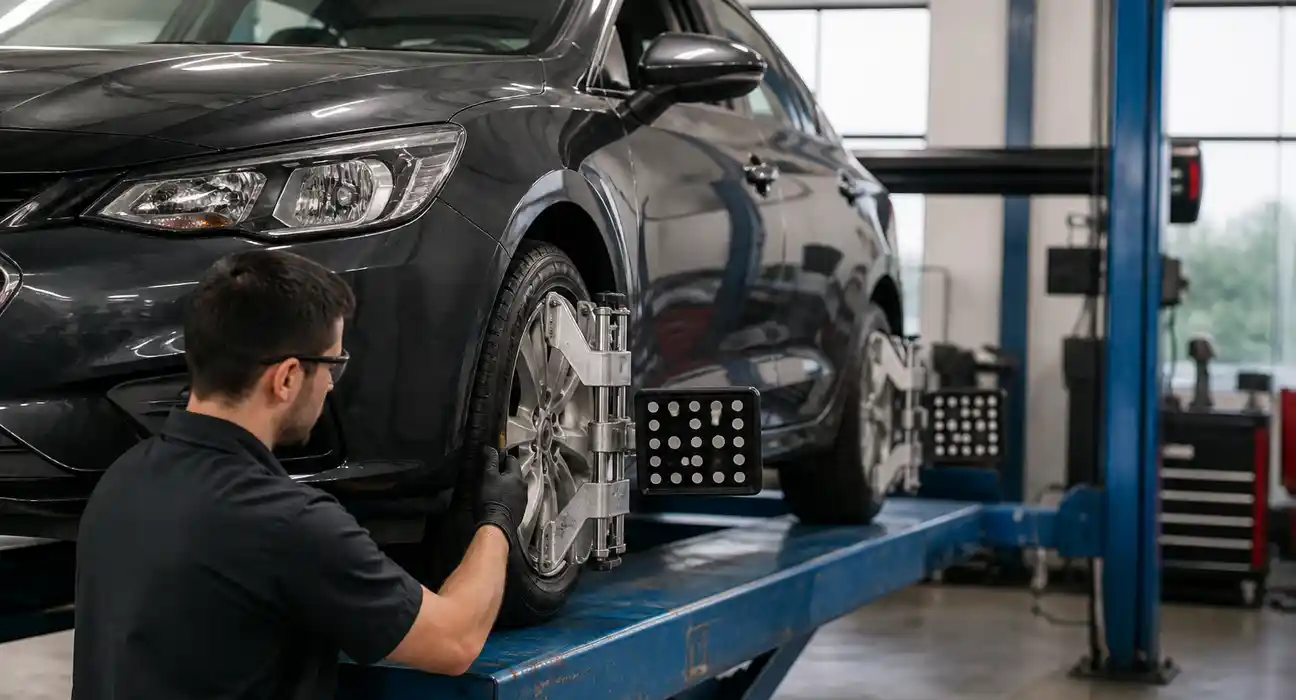
Wheel alignment is most often thrown off by potholes and curb hits. Other common causes include worn suspension parts, heavy loads, new tire installation, and collision damage.
Knowing the common causes helps you decide when to get an alignment check. You can catch problems before symptoms show up.
1. Potholes and Curb Impacts
Hitting a pothole, curb, or road debris at speed can throw off your alignment instantly. The force travels through your tires and wheels right into the suspension. This shifts the carefully set angles. On cars with ADAS, the same hit can move the camera and radar sensors out of place.
In our experience, potholes are the most common cause of alignment problems we see in the Winchester area. This is especially true after winter, when freeze-thaw cycles damage local roads. Even impacts that seem minor can change alignment. If you hit something hard enough to feel it in the steering wheel, get an alignment check.
2. Worn Suspension and Steering Parts
Bushings, ball joints, and tie rods wear out over time. As they wear, they get loose and let the alignment angles shift. The alignment might have been set right. But worn parts can’t hold those settings anymore.
Pro Tip: Have your suspension checked during alignment service. This way, you don’t pay to align wheels that won’t stay aligned. Worn parts need to be replaced before alignment will hold.
3. Heavy Loads and Lowered Ride Height
Carrying heavy loads often, such as work tools, passengers, or cargo, changes your suspension. The extra weight pushes the springs down and shifts alignment angles away from factory specs.
Aftermarket changes that lower ride height do the same thing. Any change to how your car sits usually needs an alignment adjustment to fix it.
4. New Tires Installed Without Alignment
Installing new tires doesn’t require alignment. But if you skip it, any existing misalignment starts wearing your new tires from day one.
Many drivers find out their alignment was off only after they see uneven wear on tires that should have lasted much longer. Getting an alignment check with new tire installation protects your money from day one.
5. Collision Damage, Even Minor
A fender-bender that doesn’t seem bad can still shift the suspension and move ADAS sensors. Any repair after a collision on a modern car should include an alignment check and an ADAS calibration check.
What’s the Difference Between Wheel Alignment and Tire Balance?
These two services fix different problems, but both affect how your car rides. Wheel alignment adjusts the angles of your wheels. Tire balance makes sure weight is spread evenly around each wheel. Knowing the difference helps you describe symptoms when you call to schedule service.
| Service | What It Adjusts | Symptoms It Fixes |
|---|---|---|
| Wheel Alignment | Suspension angles, including camber, caster, and toe. | Pulling to one side, uneven tire wear, crooked steering wheel. |
| Tire Balance | Weight spread around each wheel. | Shaking at certain speeds, bouncing. |
If you have shaking plus uneven tire wear, you may need both services. Shaking by itself, especially at certain speeds, usually means balance. Pulling and uneven wear point to alignment.
How Often Should You Get a Wheel Alignment?
Most cars need an alignment check once a year. You should also get one after installing new tires or after any major pothole, curb, or collision impact.
There’s no set mileage for alignment service. Driving conditions are different for everyone. It makes more sense to schedule based on events and symptoms.
Get an alignment check:
- After hitting a big pothole or curb.
- When you install new tires.
- If you see any warning signs listed above.
- As part of yearly maintenance.
- After any suspension or steering repair.
- After a minor collision or fender-bender.
- When ADAS warning lights come on.
Pro Tip: Ask your tech to check alignment during your Virginia state inspection or regular maintenance. This catches problems early. A quick check takes very little time and can spot issues before they cause expensive damage.
Wheel Alignment and ADAS Calibration in Winchester, VA
Wheel alignment affects your whole car. It impacts tire life, gas mileage, suspension health, and braking. On modern cars, it also affects the safety systems your car depends on. Catching misalignment early stops the chain of damage that turns a simple fix into a major repair. On ADAS cars, it also keeps the safety features you paid for working right.
At Mission Auto Repair in Winchester, VA, our ASE Certified Master Technicians bring over 25 years of experience to every alignment and ADAS calibration. Our team has performed alignments on hundreds of Winchester-area vehicles. We use the Autel Maxisys IA900 to do alignment and ADAS sensor calibration in one combined service. When you leave, your wheels are aligned to manufacturer specs. Your cameras and radar sensors are calibrated to match.
What you can expect:
- Full suspension and steering inspection to find the real cause, not just the symptoms.
- Alignment to factory specs using Autel Maxisys IA900 equipment.
- ADAS calibration done in the same workflow when needed.
- ASE Certified Master Technicians with decades of hands-on experience.
- Honest, transparent pricing with no surprises and no upsells.
- Fast turnaround to get you back on the road.
- 2-Year/24,000 Mile Warranty on repairs.
- Serving Winchester, Frederick County, Stephens City, Middletown, Berryville, and surrounding communities.
Schedule your wheel alignment or call us today to ask if your car also needs ADAS calibration.
Frequently Asked Questions About Wheel Alignment
Do you need a wheel alignment after installing new tires?
An alignment isn’t required, but it’s a smart idea. It makes sure your new tires wear evenly from the start. Without it, any existing misalignment will start wearing your new tires unevenly right away.
Does my vehicle need ADAS calibration after a wheel alignment?
Yes, if your car has ADAS features. Alignment shifts your car’s thrust line, and the ADAS sensors need to be recalibrated to match. ADAS features include lane keep assist, adaptive cruise, emergency braking, and other camera or radar systems. We can check whether your car needs it as part of the service.
What is the Autel Maxisys IA900?
The Autel Maxisys IA900 is a combined platform for wheel alignment and ADAS calibration. It does both services in one workflow. This lets us do precise alignment and accurate ADAS sensor calibration in a single setup. It’s essential when both services need to work together.
Can a wheel alignment fix steering wheel vibration by itself?
Sometimes, but not always. Alignment may reduce shaking caused by uneven tire wear over time. But shaking at specific speeds usually means you also need tire balancing.
Is it safe to drive with a slightly misaligned vehicle?
Minor misalignment isn’t an immediate danger. But it speeds up wear on tires and suspension parts with every mile. On cars with ADAS, it can also reduce how well safety systems work. Fixing it quickly avoids growing costs and safety problems.
How long does a professional wheel alignment service take?
A standard alignment takes 30 minutes to an hour. ADAS calibration adds more time, depending on your car and which systems need calibration. If worn suspension parts need to be replaced first, that adds even more time.
The Bottom Line
Wheel alignment affects far more than tire wear. It decides how your suspension parts age. It affects how much fuel your engine uses. It changes how well your brakes can stop the car. On modern cars, it also decides whether your safety systems get accurate information. Treating alignment as just a tire service misses what’s really at stake.
At Mission Auto Repair, we’ve served Winchester area drivers for over 25 years. Schedule an appointment if you have pulling, uneven tire wear, off-center steering, ADAS warnings, or if it’s been a while since your last alignment check. We’ll inspect your suspension. We’ll align your wheels to manufacturer specs. And we’ll recalibrate your ADAS systems using the Autel Maxisys IA900. This makes sure everything works the way it should.